


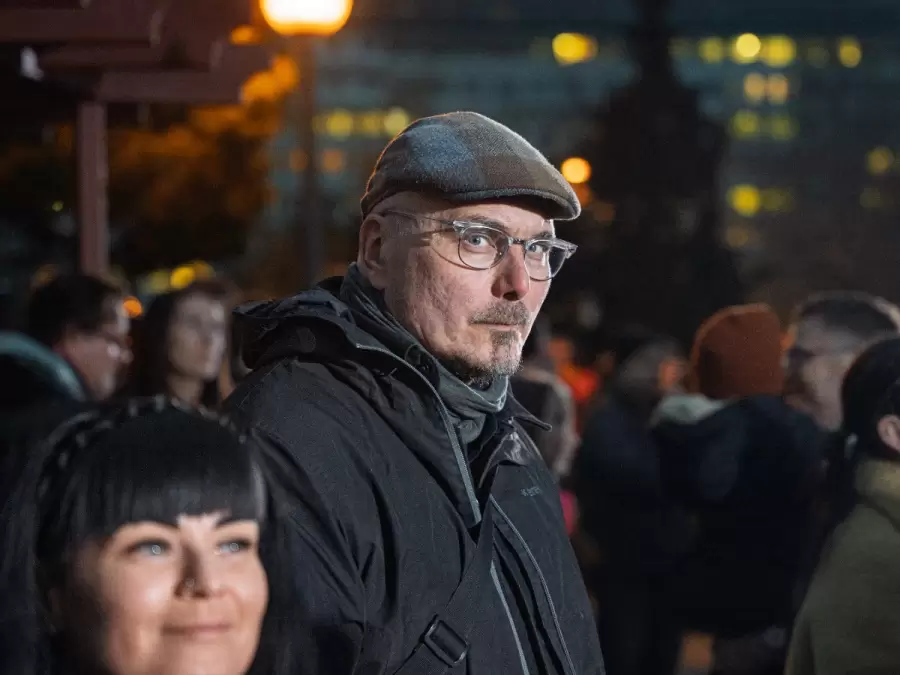
FinnAgora welcomed as its Guest of the Month journalist Sami Sillanpää, who followed Hungary’s elections on the ground this spring. He shared his experiences as a foreign correspondent during a particularly eventful political season in the country.
Sillanpää has worked at Helsingin Sanomat for nearly 30 years in a variety of roles, including leading the foreign news desk, contributing to the monthly magazine, working in investigative journalism, and serving as a correspondent. His focus has almost always been on global politics.
“I remember already as a teenager thinking it would be exciting to be a journalist. I studied at the University of Tampere, and as soon as I started working, I realized I truly enjoyed the profession. I didn’t begin my career in foreign news, but a desire to understand the world and Finland as part of it gradually led me toward international topics.”
His career in foreign reporting began with coverage of the Kosovo War in 1999. Since then, Sillanpää has worked for example as a correspondent in China and Africa, witnessing a wide range of political tensions and crises. His career has also included an unforgettable 1,700-kilometre journey along the Congo River by barge and wooden canoe, which later inspired his book Keskellä virtaa Kongo.
With such extensive experience, one might assume that little would faze him. Yet on the evening of Hungary’s parliamentary elections on April 12, he felt he was living through an exceptionally historic moment. As a foreign correspondent, Sillanpää has followed Hungarian politics closely for the past decade. This reporting trip ahead of the elections was a special assignment, as European elections are often covered only briefly.
In the newsroom, it was assessed that these elections might be more significant than usual. They also attracted broader interest across Europe. “As soon as I arrived in Hungary, I could sense a great deal of anticipation and movement in conversations.”
Sillanpää recalls the energetic atmosphere of campaign events and reporting trips to towns such as Mórahalom, Törökszentmiklós, Kiskunhalas, and Felcsút. Working with a Hungarian assistant, he found it easy to engage locals in discussions about the elections, although politicians were more difficult to reach. Some declined interviews, citing the role of the media and the sensitivity of the situation.
One of the most memorable encounters for Sillanpää was the hospitality of pig farmer Sándor Tokaji.
“Tokaji invited us into his home, and we sat down to talk about politics. This kind and thoughtful man expressed feelings that ‘ordinary’ people may experience when following politics. He spoke about wanting to retreat into his own space, away from all the ‘noise and conflict.’ It’s easy to relate to that feeling, no matter where you observe the world from.”
Perhaps the most talked-about moment of Sillanpää’s visit—and of the political spring in Europe more broadly—came on a Sunday evening in April. Like tens of thousands of others, he headed into the city to follow the election night events.
“The entire evening was a powerful experience, both professionally and personally. The celebrations that unfolded moved even me as an outsider. It felt as though something long held back was being released. Those emotions turned into tangible hope. I stood in Batthyány Square next to three very reserved-looking elderly women as the results were displayed on large screens. Suddenly, they went wild and started dancing with unrestrained joy. The sheer happiness of that moment has stayed with me as a vivid memory.”
In the early hours of the morning, Sillanpää walked home to the sound of jubilant car horns. Only an early wake-up the next day prevented him from observing the atmosphere throughout the night. After the elections, both Hungary and the international audience following the country now await signs of change with close attention.
“I’ve been positively surprised by how closely Finns have followed Hungarian politics ahead of the elections. I believe these elections have shifted Hungary’s image, and I hope that interest will continue.”
After the elections, despite his busy schedule, Sillanpää also took part in a FinnAgora discussion event, where he reflected on the events from a foreign correspondent’s perspective. He was joined by Hungarian journalist András Király from Telex. In addition to the elections, the discussion touched on the role and future of Hungarian journalism.
“There is a group of significant Hungarian journalists who, despite challenges, have remained committed to the principles of journalism, grounding their work in facts and critical inquiry. On the margins of the media landscape, independent outlets have continuously provided important information about what is happening in Hungary. Their most important contribution is their critical stance toward both, government and opposition sides.”
FinnAgora thanks Sillanpää for his visit to Hungary and for the many insightful articles he has written for Finnish audiences about the elections. We look forward with great interest to seeing where in the world he will report from next.
Text: Heta Makkonen