


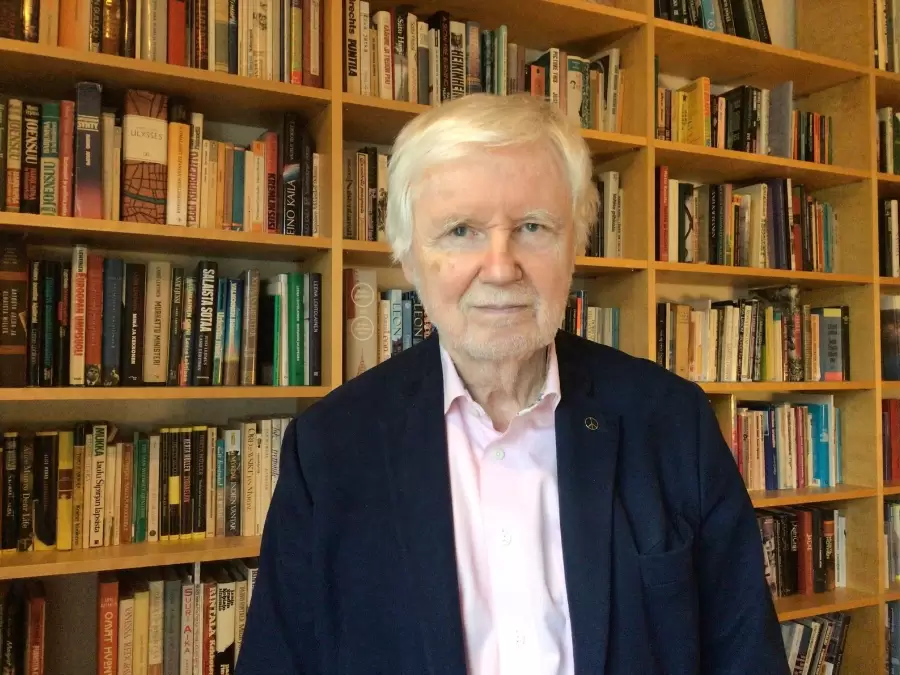
FinnAgora’s Guest of the Month for October is historian and former Finnish Minister of Foreign Affairs Erkki Tuomioja. Tuomioja, who has a long career in various international roles, currently serves as chairman of the Historians Without Borders association. He has also played a key role in the association’s founding. Historians Without Borders is a Finnish nonprofit organization that organizes events related to teaching and understanding history.
Tuomioja will give a keynote speech at the history seminar organized by FinnAgora at Central European University’s campus in Budapest on November 5th 2026, with the theme of politics of memory and the 70th anniversary of the 1956 uprising.
What memories do you have of Hungary or interacting with Hungarians?
I have to admit that, overall, I actually have very few memories of Hungary or interacting with Hungarians. For many people in my generation and older, the 1956 uprising was a significant event that brought Hungary to our attention. At the time of the uprising, I was in school in England where the Suez crisis was the biggest news story at the time. Hungary was also in the news because of the uprising, but not as prominently.
Neither do I have any Ugric connections extending all the way to Hungary, even though my grandmother is Estonian. I’ve also noticed that despite the linguistic similarities, I don’t understand a single word of Hungarian. But if Hungarians are speaking in the next room without me being able to hear the words, I think they’re speaking Finnish, because the rhythm and stress patterns are similar. That’s the only way the linguistic connection is visible.
What significance can historical research have for understanding social phenomena?
To a large extent, it’s impossible to understand social phenomena without knowing how they originated. We live in a time when people know less and less about where, when, and how we have come to the point where we are today. This is something that has concerned me for a long time, because it also means that it’s harder to picture the future and influence it. Nowadays we live very superficially: we take stands that are very short-sighted and based on short-term events, without understanding the historical roots of developments.
I’ve also noticed that history education has been cut back. Nowadays you can graduate from university without really knowing which countries were on opposing sides in World War I and World War II. This lack of historical awareness is a problem both in Finland and in other parts of the world. The main purpose of the Historians Without Borders association is to work against this development.
Tell us more about the Historians Without Borders association!
We are at the same time a Finnish non-governmental organization and the secretariat of the international Historians Without Borders network. We organize various events in Finland focused on the teaching and understanding of history. The association also organizes larger projects, such as the recent History in Exile project funded by Nordic Council of Ministers, in which we have highlighted the work of Russian historians living in exile across Europe, mostly in the Nordic countries and the Baltic states. Together with them we have organized four discussion events. Before the war in Ukraine began, we held a couple of meetings between Russian and Ukrainian historians. Although they hardly agreed on anything, they shared a common hope to keep in contact once it is possible again.
We have also participated in meetings of historians in 30 different countries, not only in Europe but also in Africa, Asia, and North America. We would like to turn the Historians Without Borders network into an international organization, but that’s only possible once there is a credible number of local associations around the world. For now we are a network with hundreds of historians from all over the world as our members. Our next joint meeting will be in London, one week before the history seminar in Budapest.
How does the association choose the topics for its events?
Seminars are held on current issues, for example on what is happening in Russia. The field of Russian historical research is free and open, but honest historiography has become impossible in the country. This has led to a growing number of Russian historians living in exile. We have tried to bring them together and encourage them to challenge the state-controlled historiography.
Similar problems with distorted historical writings also exist in democratic countries, for example in the discussion on the history of colonialism. We organize many events on this topic and have an active working group focusing on the history of colonialism. We hope that EU funding could also be used to teach this kind of history. Seminars are also held on the anniversaries of the various historical events, such as an online event addressing the events of 1918 in Finland, when we discussed Finnish history and how complicated events can be analyzed today. It has taken over 100 years before the Civil War of 1918 could be openly discussed without the opposing parties taking sides.
Why do you want to be part of the association?
The association was founded on my initiative. Both as a historian and during my long career as the Minister of Foreign Affairs, I came across situations in which history was used to prevent resolution of conflicts and concluding peace treaties. In other words, history was being misused. We wanted to bring together experts, first in Finland and later internationally, so that professional historians would be available specifically to help resolve various conflicts and engage in open dialogue on difficult topics. This would enable us to find common ground and advocate for the use of history in preventing conflicts and fighting against hate speech.
The majority of our members are Finnish history professors. However, the association is not just an organization of professional historians, as we also have professionals involved in international politics, diplomacy, and communications as our members.
What thoughts does Hungary’s current political situation bring to your mind?
The situation brings encouraging thoughts. For a long time, Hungary was a subject of concern in Europe, as the country’s constitutional state was being undermined and divisions were created. Historians Without Borders also held an event a couple of years ago that addressed the situation in Hungary. It is very encouraging to see how after the election results the focus is now on how to break down the distortions that have emerged during Orbán’s long reign and restore the constitutional state as well as respect for human and minority rights.
What are your feelings about coming to Budapest and what are your expectations for the upcoming seminar?
I find the history seminar very rewarding. It gives me the opportunity to gain a deeper understanding of what’s happening in Hungary and how the work that began after the elections is moving forward. Observing the situation firsthand and feeling the atmosphere is important, because you cannot learn everything just from the media. You can get a much clearer picture by talking face-to-face with people on the spot. All the topics and themes covered in the history seminar are interesting, rewarding, and very diverse. I’m looking forward to attending in person to get the most out of the event and to learn something new.
Is there anything else in Budapest that interests you?
I’ve been to Budapest on very short visits, maybe three or four times. The city is full of layers of history that are revealed through different places. I have read about Hungarian history in books, but seeing the actual locations where those events took place adds a whole new dimension. Budapest is a beautiful city with beautiful buildings that shows the architectural heritage of its era as a great power. Through the architecture, you can sense a past world that no longer exists.
Text: Wilma Dahlström