


Turku-based visual artist Matti Lankinen works with street art, murals, graffiti and community art. Born in Kangasala in 1988, Lankinen is particularly known for his public art projects and for his long-term work developing the Hiedanranta Street Art Park in Tampere together with the Spraycankontrol ry collective between 2016 and 2020. Hiedanranta grew into one of Finland’s most significant open-air street art environments, featuring works by hundreds of artists from around the world.
Lankinen’s work combines art, participation and community building. His aim is not simply to create works for people to look at, but to create situations where people can participate, reflect and express their own thoughts. “I want to encourage people to think for themselves rather than simply accepting things as self-evident,” Lankinen emphasises.
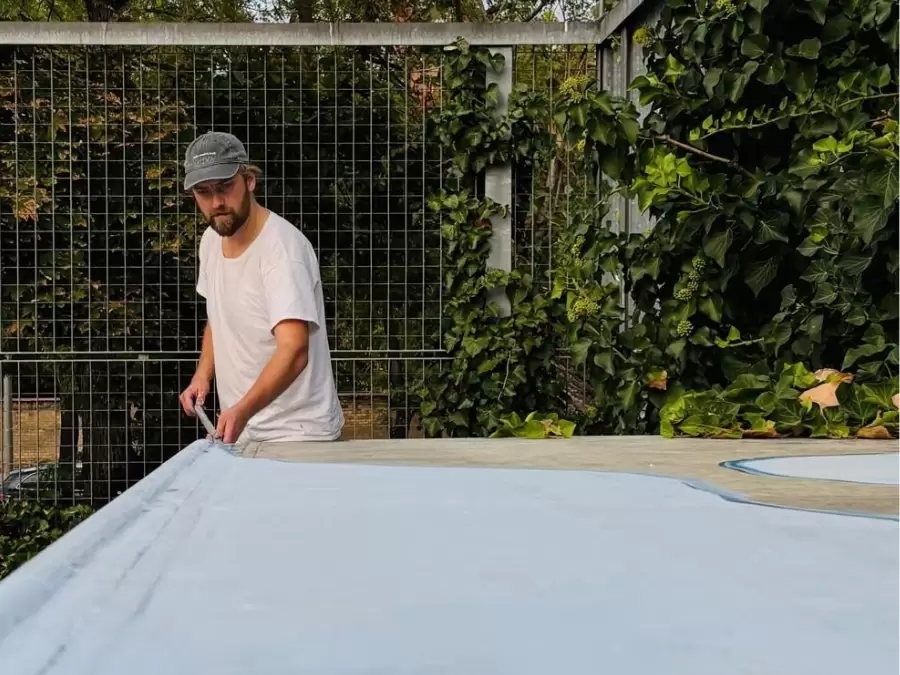
This autumn, he visited Budapest to lead a street art workshop in the Józsefváros district as part of the Budapestünk event organised by FinnAgora in cooperation with the FiDo Youth Centre. The workshop brought together children and young people of different ages, as well as local community members, to paint a collaborative work of art at the skate park on the roof of FiDo.
.jpg "Lankinen ohjaamassa työpajan osallistujia värittämään FiDo:n katolla sijaitsevaan rullalautailupuistoon tulevaa muraalia 12.9.2026.")
Lankinen guiding workshop participants as they painted a mural for the skate park on the roof of FiDo on 12 September 2026.
Lapsuuden graffiteista alkoi elinikäinen kiinnostusA lifelong interest sparked by childhood graffiti
Lankinen’s relationship with street art began in childhood in Kangasala, where there were few spaces or natural meeting places for young people between the forest and the suburbs. Against this backdrop, the colourful graffiti tunnels along his route to school sparked a strong sense of curiosity and wonder that gradually developed into a creative practice of his own. Spray paints became part of Lankinen’s hobbies in the late 1990s, and over the years graffiti became not only a form of artistic expression but also a way of discovering new people and places. Travel, street art and skateboarding have long gone hand in hand in his life.
What particularly fascinated Lankinen about street art was its sense of freedom and the opportunity to work in unconventional environments: “There’s something exciting about painting in a tunnel, on wasteland or in an abandoned building – it’s a bit like working in a haunted house.”
Among Lankinen’s best-known recent street art works is Maailman nopein kansa (The Fastest People in the World), a 90-metre-long mural completed in 2020 inside a tram tunnel in Tampere. The work reflects on the Finnish national psyche and encourages people to challenge the Anglo-Saxon concept of time in their own lives: could a rhythm adapted to changes in natural light support wellbeing better than a life governed by the clock for living in Finland?
In addition to street art, Lankinen also works with mosaic art. His interest in traditional artistic techniques has taken him, among other places, to paint a monastery in Cairo and explore the cultural heritage of the Mediterranean region. Budapest’s ornate thermal baths and their mosaics have also left a strong impression on him.
Studies supporting increasingly ambitious public art projects
Lankinen graduated as a visual artist from Turku Arts Academy in 2023 and is currently completing a Master’s-level degree in Fine Arts in Lappeenranta. He has also studied silver and bronze casting in Valencia. Lankinen completed his first public sculpture project in 2025 as part of a team with a colleague. They created a series of concrete sculptures inspired by Finnish sauna traditions in Kaarina. His familiarity with the material dates back to the DIY culture of building skateboarding spots in Tampere’s Pispala and Hiedanranta.
Through his studies, Lankinen’s expertise has expanded beyond artistic practice to include public art consultancy, the planning of percent-for-art programmes, project management and the production of art programmes. Under the percent-for-art principle, 0.5–2 per cent of a new building or construction project’s budget is allocated to art, which is integrated into the shared environment from the planning stage onwards.
In public art projects, artists often work between a wide range of different stakeholders. Alongside creativity, the work requires collaboration, communication skills and the ability to bring together different perspectives. Lankinen draws on these skills also in his public art consultancy work with cities and residential areas in the Pirkanmaa region, working with specialist companies and art museums on mural projects.
Street art workshops as a way of building community and wellbeing
Lankinen has been leading street art workshops for more than ten years. Participants have come from a wide range of backgrounds and age groups, including preschool children, school classes, young people, people from immigrant backgrounds, people requiring additional support, and senior citizens.
The most important goal of the workshops is not a technically flawless final result, but a sense of participation. “The aim is to encourage people – to leave them with the feeling that they can and are allowed to create, and that they are capable of expressing themselves,” Lankinen emphasises.
.jpg "Lankisen vetämä työpaja FiDo:lla keräsi mukaansa osallistujia eri ikäluokista.")
Lankinen’s workshop at FiDo brought together participants from different age groups.
According to Lankinen, graffiti painting works particularly well for this purpose because the results can be seen quickly and the activity does not require prolonged concentration on a single artwork. Many participants are surprised to discover their creative side specifically through street art. In addition, when people get to influence their shared environment, their relationship with the place evolves.
“Street art can be a great way of bringing a group together,” Lankinen states. “When people feel that they have had an opportunity to influence a shared space, they also want to take better care of it and feel that the space belongs to them.”
Lankinen points out that the human desire to leave a mark on one’s surroundings is much older than graffiti. Cave paintings, engravings on walls and contemporary street art all seem to stem from the same innate need to communicate: I was here, too. Lankinen has also followed the changing status of graffiti in Finland. In his view, the strong prejudices associated with the art form, particularly in the early 2000s, have gradually diminished, and graffiti is increasingly regarded as a valued part of urban culture and art.
Peaceful dialogue through art
At its best, street art can bring together people who might otherwise never meet. Painting together can easily transcend linguistic, generational, cultural and even political divides. For this reason, community art is increasingly being used to strengthen wellbeing, participation and social cohesion. This can also be seen in the international research and development projects to which Lankinen has been invited as a street art expert. For example, at the INURA conference organised by the University of Tampere in 2025, Ukrainian participants explored how graffiti and community-based art activities can support wellbeing in times of crisis and conflict while fostering dialogue.
.jpg "Yhteisötaide voi lisätä paikallista hyvinvointia rakentamalla kuuluvuuden tuntemuksia.")
Community art can contribute to local wellbeing by creating a sense of belonging.
The idea of art as a catalyst for dialogue is also present in Lankinen’s own work. In 2024, he created the Peacemaker mural at Tampere’s Ratina Stadium, depicting President Martti Ahtisaari as a peace mediator (watch a video of the painting process here). The work was created at a time when the war in Ukraine dominated public discussion across Europe.
“I felt I needed to create an image of someone known as a negotiator and advocate for peaceful solutions. Maybe it will make people reflect on whether more could be achieved through negotiation rather than through war.”
Ahtisaari’s distinctive portrait amid the graffiti reflects Lankinen’s view of art: its role is not to provide ready-made, absolute answers, but to invite people to engage in discussion, participate and look at their surroundings as well as the thoughts they evoke from a new perspective.
The first, but hopefully not the last, workshop in Budapest
The street art workshop in Budapest was Lankinen’s first workshop experience abroad. What stayed with him most was the enthusiasm of the participants. Although a common language was not shared with everyone, creative activity quickly overcame any language barriers. Painting together created a space where young people from different backgrounds could work side by side towards a shared goal and leave their own mark on the artwork. Lankinen also had positive things to say about his collaboration with FinnAgora.
“The cooperation was smooth, and there were plenty of materials and paint. It was a really warm atmosphere,” Lankinen says.
The visit left him with a positive experience, and he could easily imagine returning to Budapest in the future for new projects. Next on Lankinen’s agenda are graffiti workshops for young people in Naantali and the continuation of his studies.
FinnAgora thanks Lankinen for his visit to Hungary and for engaging local children and young people in creative collaboration!
Text: Lotta Laitila
Photos: Nuutti Päällysaho