


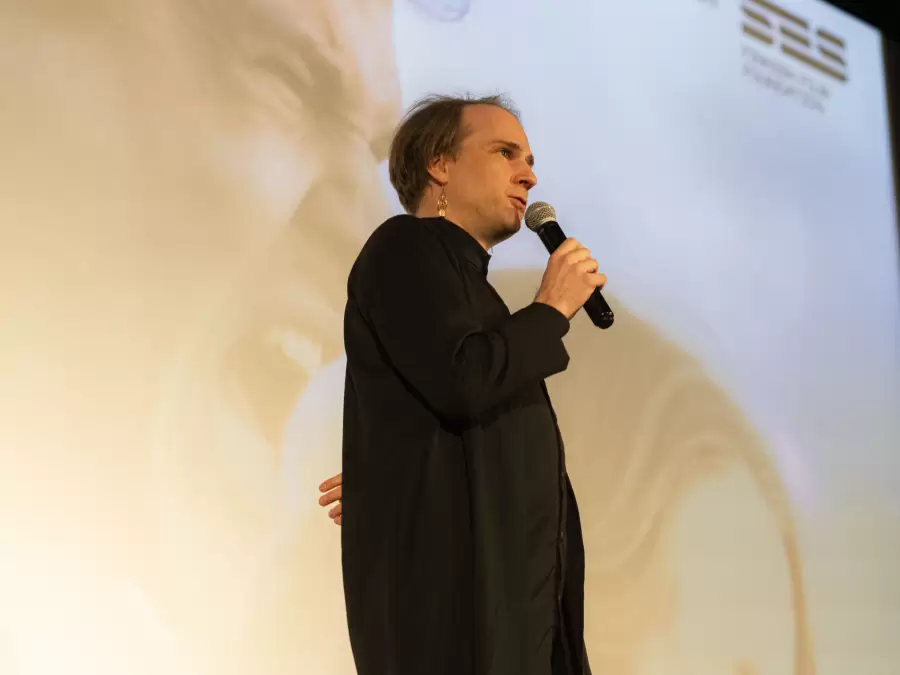
Lauri-Matti Parppei (b. 1984) is a Finnish film director, screenwriter, composer, and musician, whose works explore themes of love, loneliness, and friendship, while challenging traditional gender roles. Their expression combines personal storytelling, humor, and a rebellious DIY spirit.
A Light That Never Goes Out is Parppei’s feature debut, telling the story of Pauli, a classical flutist who returns to his small hometown of Rauma to recover from a burnout. Meeting Iiris, an experimental musician, draws Pauli into exploring the power of collaboration, finding comfort and inspiration in their shared sonic experiments. In February, the film charmed the Budapest audience at the opening screening of the Finn Filmnapok festival, where Parppei also participated in a Q&A session to share their thoughts with the audience. Before the festival, Parppei—then touring Europe with the film—also took the time to meet with us for an interview.
Hi Lauri-Matti! In the end credits of A Light That Never Goes Out, your name appears in several different roles. Was it clear from the beginning that you would be responsible for so many areas? What did you ultimately end up doing?
When it comes to writing, composing and directing, it was clear from the start that these would be my responsibility, since I have done these things in my previous works as well. Over the course of creating this film a lot of other things came along too, first and foremost for budgetary reasons. It's more convenient to have the director do things than to hire outside professionals. I also designed the film’s domestic poster, which perhaps didn’t turn out as commercial as it could have been. In addition to producing the music, I also recorded it and built the necessary equipment. The last time I had done soldering was in elementary school, and of course all the equipment broke down in the middle of filming. At this point it is probably obvious that I was also the one fixing it between takes. I probably would have had something more important to do at that stage.
How did you become a film director?
As a child, after seeing Star Wars, I thought it would be great to make films. But for a long time I didn’t take that dream very seriously. I also didn’t think it was in any way possible for ‘a regular guy from Rauma’. I was lonely in my hometown, but after high school I met people with whom we believed we were making world-class art.
That’s where I began to draw courage from. We didn’t know how to do anything, but we were certain we could learn anything. We made records, organized events and experimented with all kinds of things. At the same time, I worked as a graphic designer, for example laying out coupon booklets for fast-food drive-in grills. All of us worked primarily to finance our own art.
At some point I tried making a music video for our band and realized it brought together all my interests: music, text, visuals, sound and rhythm. That’s when I thought maybe I should try this seriously. A few years later, I dared to apply to film school. Making films as a profession happened almost by itself. I didn’t apply to film school to earn money — the most important thing was to learn the craft. My background is deeply rooted in the DIY world, and that mentality has shown itself as a kind of ruthlessness at many turning points in my career. For example, I’ve been uncompromising about not wanting to direct anything I haven’t written myself. Fortunately, that choice has been possible. I know it’s quite unique.
What kind of relationship do you have with your hometown and the film’s setting, Rauma? Do you live there now, and if not, do you ever dream of moving back?
Unfortunately, I live in Helsinki, but Rauma is and always will be important to me. Most of my friends have been with me since those days. It was wonderful and also surprising to be able to make this film in Rauma. For years I had been tinkering there on a shoestring budget, with miscellaneous equipment found here and there, and suddenly I arrived in the city with a film crew to make a real film with a real budget.
It has also been delightful to see how warmly the film has been received in Rauma. I’m grateful for that, as my earlier art hasn’t always resonated with the people there. My work and life are rooted in Helsinki, but many people close to me seem to be feeling the pull back to Rauma. In a small town, there’s something appealing about the impact of culture. Things materialize quickly — as if you strike a match in a dark closet and it instantly bursts into bright light. In bigger cities, things easily disappear into the noise.
The film’s protagonist Pauli is a talented musician who, in addition to mental health struggles, grapples with lost creativity. When a hobby becomes a profession, many people experience something similar. Is Pauli’s story in some way also your story?
In short, Iiris in the film is like me when I was young — uninterested in structures or hierarchies and constantly in a rush to do things. When I found even a few like-minded people in Rauma, I had to hold on to them. The principle was that if you knew one guitar chord, you could join the band.
When we were making culture at a grassroots level, no one defined or really evaluated what we were doing; we operated outside structures. With film school, I kind of stepped inside those structures, and that has at times led to cynicism towards my own work. Ideas feel pointless until a funder gets excited about them. Embracing failure and being inspired by imperfection have turned into a fear of making mistakes.
In the original script, Pauli wasn’t supposed to be a classical musician. But I got to know professionals from the field and realized that our experiences were surprisingly close to each other’s. They described how their musical passion had been narrowed down by structures and expectations. That resonated strongly with my own experiences. There’s a lot of me in Pauli, now as someone who has gone through film school. Making A Light That Never Goes Out was a contradictory experience: the story is about letting go and stepping outside structures, even though the entire process took place within them.
The soundtrack of your debut feature is absolutely stunning. One particularly memorable song is “Finnish Lighthouses,” which, as the name suggests, lists Finnish lighthouses. Is it just a random list, or do you have a special interest in lighthouses?
The song existed long before the film. I once taught myself to play drums and made an HC punk track that needed lyrics. I ended up on the Wikipedia page listing Finnish lighthouses. I offered the song to my band, but they weren’t interested. For the film, I wanted a piece with strong expression and symbolism, and that banal list of Finnish lighthouses came back to me. During filming, a lighthouse painting appeared in the set design, and it actually featured completely different lighthouses than those in the song. At the opening screening, I jokingly said I hoped no members of the Finnish Lighthouse Society were present because of the incorrect list. Three people raised their hands and revealed they had come to see the film precisely because of the song. They weren’t offended at all, just kind and forgiving. Maybe lighthouses could become a fun hobby.
The film has been described as European. How did you aim for that atmosphere?
First, a small anecdote about Rauma’s self-confidence. During Russian rule, when state funding wasn’t granted, Rauma decided to build a railway at its own expense. The townspeople chose to build it on a European gauge instead of the domestic one. The thinking was already oriented toward dreams of independence and a European Finland. In practice, trains had to switch wheels in Kokemäki, which didn’t make much sense, but it was about attitude.
In a way, we approached this film similarly. We wanted to avoid easy solutions and choose classical cinematic storytelling techniques. Carefully composed images also supported the tight budget. The film was presented at the Les Arcs festival in the Alps, where we watched scenes from ten different European films in a row. After seeing our own film, I thought: this is as Finnish — and especially as Rauma — as a film can be.
I’m proud of how well A Light That Never Goes Out has been received in Europe. I think that maybe unlike Rauma’s railway, our tracks were ultimately worth building to European gauge. The film has toured European festivals and is currently in distribution in France, and soon also in Norway and Greece.
What would you most like viewers to take away from the film?
I hope that everyone will start a band. Or any kind of group built around hope, community and creating together. You can’t make it alone, even though people keep retreating into their homes and suffering from loneliness. I hope everyone gathers some kind of group around them and starts playing. Maybe it will change or even save their life, as it did in my case.
It’s wonderful to have you here to have you here in Budapest at Finn Filmnapok. Do you have any connections to Hungarian or other Eastern Central European cinema and cultural fields?
The recently deceased Béla Tarr was one of my favorite directors. He expanded my understanding of what cinema can be. I’ve seen his film Sátántangó three times — which means I’ve spent more than a full day of my life with it.
What can we expect from you next?
I’m currently working on a vampire film set in Kokemäki in 2002. It explores themes of loneliness, friendship, finding one’s community and chosen family. I keep dealing with the same themes, because those are things I know a lot about.
Text: Heta Makkonen